
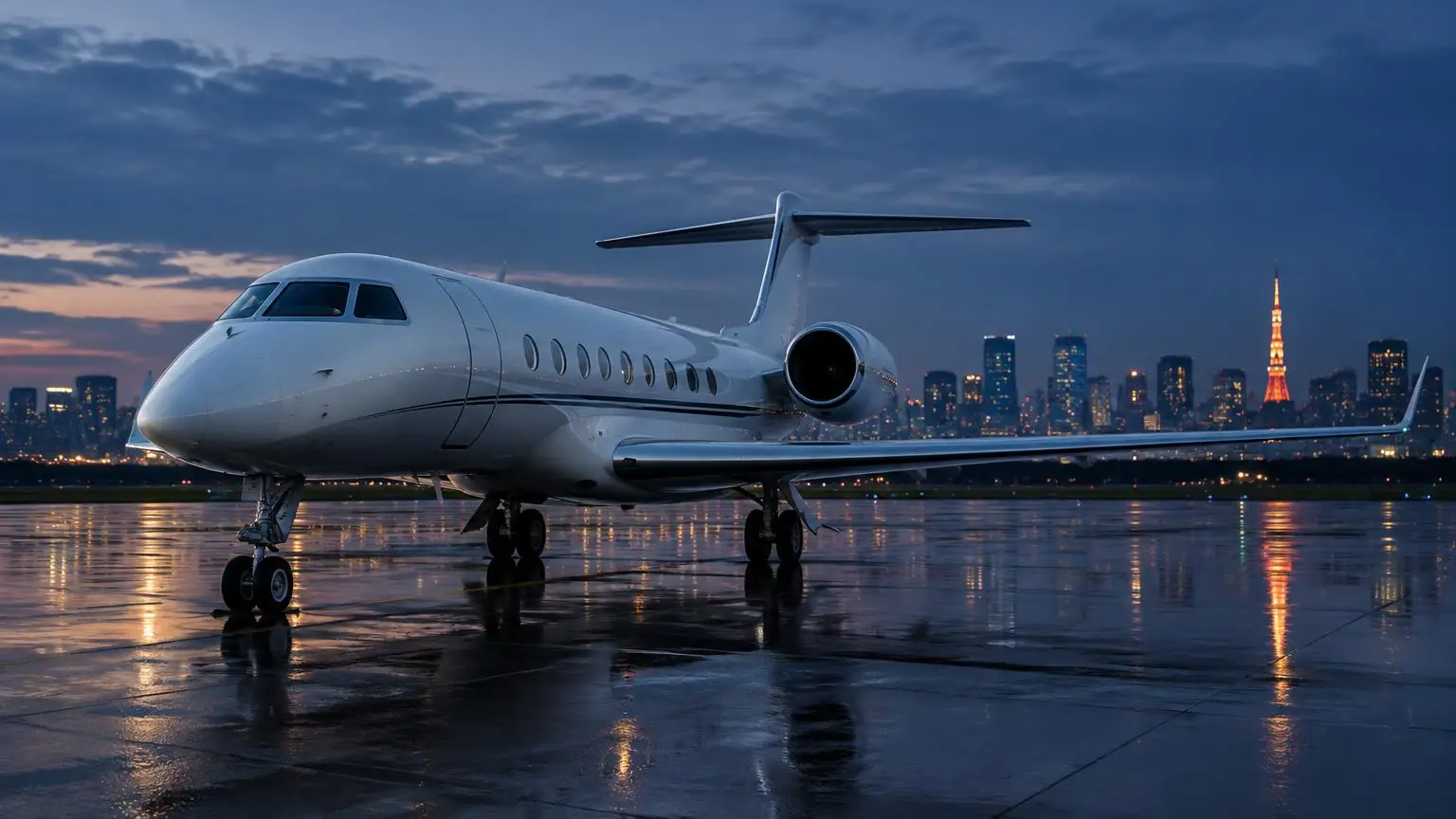
Private Jet Charter Tokyo
Private jet charter Tokyo: planning around two very different airports
A private jet charter to Tokyo is usually a long-haul decision. Most enquiries come from Asia-Pacific financial centres, the Gulf, Europe or North America, and the journey is often tied to board meetings, investor visits, product launches or a family trip that continues to Kyoto, Osaka or the ski resorts of Hokkaido. The first question is not which jet looks most comfortable, but where in Tokyo you need to be, at what time, and what happens after landing.
MEGA Aviation provides operator-led private aviation and aircraft management services and coordinates charter enquiries with appropriately licensed partner operators. Commercial air transportation is performed by the selected operator under its own air operator certificate, and the named operator, aircraft and conditions are confirmed in the written proposal before you commit.
Haneda or Narita: which Tokyo airport suits your trip?
Tokyo is served by two international airports that matter for business aviation. Haneda (HND / RJTT) sits on Tokyo Bay, close to central districts such as Minato, Chiyoda and Shinagawa. For many visitors it is the convenient choice because the drive into the city is comparatively short. Narita (NRT / RJAA) lies in Chiba Prefecture, considerably further from the centre, but it has its own business aviation facilities and can sometimes offer more flexibility on timing and parking.
Both airports are busy commercial hubs. Access for non-scheduled flights depends on slot availability, parking capacity, the aircraft type and the purpose of the flight, and the picture can change from week to week. A good proposal explains which airport has been requested, why, and what the alternative would be if the first choice cannot be confirmed for your times.
When Haneda makes sense
Haneda is usually preferred when time in central Tokyo is the priority: a same-day meeting, a short stay or passengers who want the quickest road connection. Because demand is high, requesting it early and keeping arrival times flexible improves the chances of a workable plan.
When Narita makes sense
Narita can suit longer stays, aircraft that need extended parking, or itineraries heading east of the city. The longer ground transfer should be built into the schedule rather than treated as an afterthought.
Aircraft for long-range flights to Tokyo
Distance shapes most Tokyo charters. From Singapore, Hong Kong or Seoul a super-midsize or large-cabin jet may be suitable depending on passengers and baggage. From the Gulf, Europe or the US West Coast, an ultra-long-range aircraft is often considered so the trip can be planned with as few technical stops as possible. Whether a route can be flown nonstop depends on the specific aircraft, its payload, seasonal winds, the departure runway and the operator's own planning, so any nonstop claim should be confirmed in writing for your exact dates.
Cabin choice also matters for overnight sectors. If passengers want flat beds, a separate rest area, a dedicated crew rest compartment or Wi-Fi over the Pacific, list those needs at enquiry stage. Not every aircraft in a category offers the same layout, and it is better to rule out an unsuitable cabin before a proposal is prepared.
Useful starting points include our pages on private jet charter Singapore, private jet charter Hong Kong and private jet charter Seoul for regional legs, and private jet charter Los Angeles or private jet charter London for intercontinental departures.
Japan permits, cabotage and arrival formalities
Foreign-registered aircraft operating non-scheduled flights into Japan generally require permission from the Japanese civil aviation authorities, and the operator applies for it with the passenger and flight details it needs. Lead times vary, so last-minute requests may be possible on some dates and not on others. Japan also restricts domestic carriage by foreign aircraft, which means a flight from Tokyo to another Japanese city may need a different solution from the international sector. Mention any internal Japanese legs at the start so the plan is built correctly.
Passengers clear immigration, customs and quarantine on arrival. Each traveller should check visa requirements for their nationality, carry passports with sufficient validity and declare any restricted items. MEGA does not provide visa or legal advice; we simply make sure the information the operator needs is collected early.
Getting from the aircraft into Tokyo
Tokyo traffic can be slow at peak times, and the right ground plan depends on your destination in the city. Tell us the hotel, office or residence address and whether you need a car, a larger vehicle for luggage or separate cars for different parts of the group. If you are moving on by Shinkansen to Kyoto or Osaka, include that connection so the arrival time works with the rail timetable. We avoid quoting fixed transfer times because they depend on the day, the hour and the route.
Common Tokyo itineraries
Business visits
Short executive trips often combine Tokyo with Seoul, Shanghai, Hong Kong or Singapore. A multi-stop plan works best when each sector, meeting time and overnight stop is listed so the operator can check crew duty limits and airport access together.
Leisure and ski travel
Winter visitors frequently continue to Hokkaido for skiing, and spring and autumn bring cherry blossom and foliage seasons when demand rises. Large ski bags, golf equipment and extra luggage should be described with approximate sizes before an aircraft is selected.
Events and launches
Major conferences, exhibitions and sporting events can tighten airport capacity. If your trip is tied to a fixed event, request it as early as you can and keep a fallback time window.
Why travellers choose a private jet for Tokyo
On long-haul routes the main benefit is control over the schedule. Instead of fitting meetings around airline departure banks, a group can request a departure time that suits them, travel together in one cabin, and work, rest or hold confidential conversations on board. For senior executives arriving for a short visit, avoiding a connection in another hub can protect a full working day in Tokyo. Families value being able to travel with children, elderly relatives or pets in a familiar space, subject to the rules that apply in Japan.
Private aviation is not automatically faster on every route. Slots, permits, parking and ground transfers all need planning, and on some dates a scheduled flight in a premium cabin may be the more practical option. We would rather say so honestly than overpromise.
Costs and how proposals are priced
Charter pricing for Tokyo depends on aircraft category, total flying hours, positioning of the aircraft, crew duty requirements, overnight stays, airport and handling charges, and any permit or parking costs. Because these vary with each trip and each operator, we do not publish fixed prices. Each proposal should show what is included and what may be charged separately, such as de-icing, catering, or extra waiting time, so you can compare like with like.
Travelling with pets, medical needs or special cargo
Japan applies strict rules to animals, medicines and certain goods entering the country. Pets usually need specific documentation and advance notification, and some medications require prior approval. Raise these items at the very start of planning so the operator and handling agent can confirm what is acceptable before the aircraft is booked.
How to make a Tokyo charter quote accurate
The more complete the brief, the more useful the proposal. Please include departure city, preferred dates and times, number of passengers, luggage and any oversized items, preferred Tokyo airport, onward Japanese travel, catering or dietary needs, and whether anyone travels with pets. Compare proposals on the named aircraft, operator, routing, inclusions and cancellation terms rather than price alone. You can also read about worldwide private flights and our multi-city private jet charter planning approach.
Frequently asked questions
Which airport is best for a private jet to Tokyo?
Haneda (HND) is closer to central Tokyo and is often requested first, while Narita (NRT) is further out but can offer more flexibility. The operator confirms slot, parking and handling availability for your dates before the plan is final.
Can a private jet fly nonstop to Tokyo from Europe or the Gulf?
Some ultra-long-range aircraft may be able to, depending on passengers, payload, seasonal winds and runway conditions. Nonstop capability is confirmed by the operator for your specific aircraft and dates, never assumed.
Do I need a permit to fly a private jet into Japan?
Non-scheduled international flights by foreign-registered aircraft generally require Japanese authority permission. The operating partner applies for it, so allow as much lead time as possible and share passenger details promptly.
Can the same jet fly me from Tokyo to Osaka or Sapporo?
Not always. Japan restricts domestic carriage by foreign aircraft, so internal legs may need a different aircraft or arrangement. Tell us about any domestic sectors at enquiry stage.
How much luggage can I bring?
It depends on the aircraft's baggage compartment and the payload needed for the route. Describe ski bags, golf clubs or bulky items with approximate dimensions so a suitable aircraft can be proposed.
What details should I send with a Tokyo enquiry?
Your route, dates, preferred times, passenger numbers, luggage, preferred airport and Tokyo address. With these, the team can request a proposal that names the aircraft, operator and conditions.
Plan your Tokyo flight
Send your route, dates, passenger list and Tokyo address through the existing enquiry form. MEGA will review the request with suitable licensed partner operators and return a proposal that names the aircraft, the operating carrier and the conditions that apply.