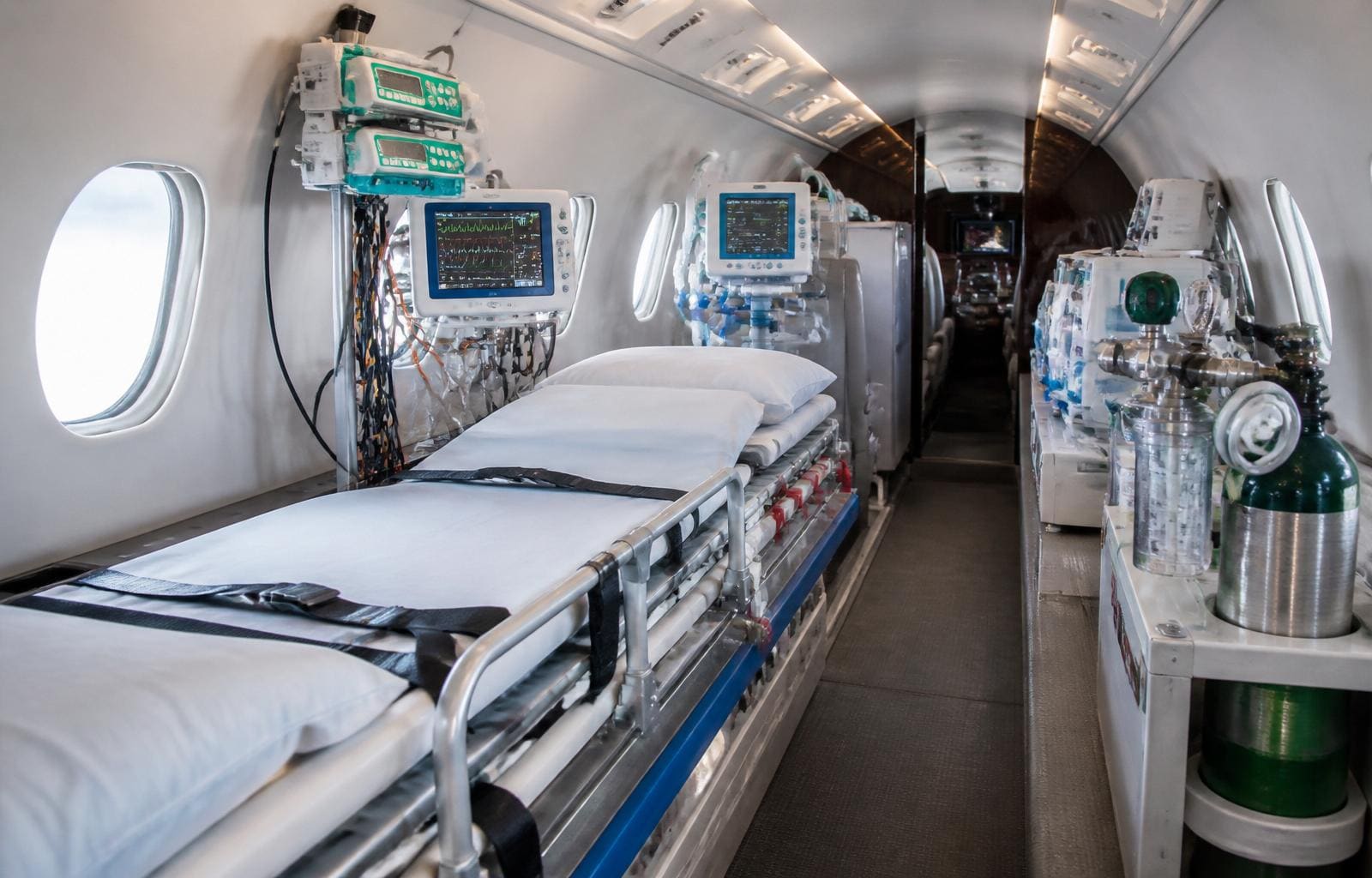
Air Ambulance London — ICU Medevac & Medical Repatriation
London · LTN · FAB · BQH · STN
London is the single busiest treatment-travel destination for patients from the Gulf, and it is also where a great many visitors need bringing home after an admission. Both directions are handled by the same medical operations desk, with the London hospital network — teaching hospitals, private groups and the Harley Street cluster — mapped in advance rather than researched under pressure.
Airport choice matters more in London than in most cities. Four business-aviation fields serve the capital, and the right one depends on which hospital the patient is going to or coming from, and on the time of day the ambulance has to make the journey.
Airports used for London medical flights
- LTN / EGGW — Luton: The workhorse for London medical flights. Strong business-aviation handling, wide operating hours and reasonable road access to the north and central hospital clusters.
- FAB / EGLF — Farnborough: Business-aviation only, calm ramp environment and good access to hospitals south and west of the city.
- BQH / EGKB — Biggin Hill: Convenient for south-east London and Kent, with quick ramp turnarounds.
- STN / EGSS — Stansted: Used for larger medical aircraft and long-range intercontinental legs where handling capability outweighs road distance.
Medical cabin options
- Midsize medical jet — European sectors — Geneva, Frankfurt, Milan, Madrid — with equipment and escort capacity.
- Large-cabin medical jet — Gulf and North African routes with a full clinical working area around the patient.
- Ultra-long-range medical — Nonstop to the Gulf, South Asia, the Far East and North America.
- Commercial medical escort — Where a stretcher is not clinically required, a physician or flight nurse accompanies the patient in an airline cabin — a proportionate option for stable patients.
Medical corridors flown from London
- London ↔ Riyadh / Jeddah / Kuwait / Doha — Treatment travel from the Gulf and repatriation home after admission. Long-range medical cabins so the team works uninterrupted.
- London ↔ Dubai / Abu Dhabi — Two-way traffic — UK nationals repatriated from the UAE, and UAE patients travelling for specialist care.
- London ↔ European cities — Geneva, Frankfurt, Munich, Milan and Madrid, largely repatriation of UK residents taken ill abroad and transfers to specialist units.
- London ↔ Delhi / Mumbai / Karachi — Repatriation of patients who wish to be treated or convalesce at home, flown as escorted stretcher transfers or full ICU depending on acuity.
- London ↔ North America — Ultra-long-range nonstop repatriation where an en-route stop would add clinical risk.
Bed-to-bed ground transfers
- Airport choice is decided by hospital location and traffic, not by habit. A shorter flight into the wrong field can cost more time on the road than it saves in the air.
- Ground ambulance is booked to meet the aircraft on the ramp at both ends, with the receiving hospital's admissions team briefed on timing.
- For inbound treatment travel, admission slots are confirmed with the hospital before the aircraft is committed.
Documentation and clearances
- UK entry requirements for the patient and any accompanying family member are checked at enquiry stage; this is a frequent cause of avoidable delay on inbound cases.
- Clinical records, imaging and a current fit-to-fly assessment are transferred to the receiving team ahead of arrival.
- Controlled drugs carried on board are documented to UK requirements and those of every country on the routing.
- Insurer authorisation, where an insurer is involved, is progressed alongside the clinical preparation rather than in sequence.
Costs
Medical flights are quoted per case. Distance, aircraft category, medical crew and equipment, permits, positioning and the dates all move the figure, so a published rate would not be accurate. You receive a written quotation with the configuration set out before anything is committed.
Related pages
- Medevac coverage — all cities
- Air ambulance services
- International medical repatriation
- Private jet charter Riyadh to London
Frequently asked questions
Which London airport is best for an air ambulance?
It depends on the hospital. Luton suits north and central London, Farnborough the south and west, Biggin Hill the south-east, and Stansted larger long-range aircraft. The decision is made on total door-to-door time, not flight time alone.
Can you bring a patient from the Gulf to a London hospital?
Yes — this is one of our most frequently flown patterns. Admission is confirmed with the receiving hospital before the aircraft is committed, and the flight physician manages the patient continuously through to handover.
Do you repatriate UK residents taken ill abroad?
Regularly, from across Europe, the Gulf, Asia and Africa. The mission is planned bed-to-bed, with the NHS or private receiving facility briefed and the ambulance meeting the aircraft on the ramp.
Is a full air ambulance always necessary?
No. For stable patients who do not need a stretcher, a medical escort in an airline cabin can be clinically appropriate and considerably more proportionate. We will say so when it applies rather than sell an aircraft that is not needed.
How is the hospital handover managed?
The flight physician gives a direct clinical handover to the admitting team, with the records transferred at the same time. Nothing is left to a paper envelope and a hope.
How do I request a London air ambulance?
Call +1 650 550 2734 at any hour or email charter@mega.aero with the patient's location, condition and the receiving hospital if it is already known.
Missions are flown by registered third-party operators with medically configured aircraft. Clinical acceptance by the receiving facility, crew and equipment suitability, permits and weather all govern departure.
Medevac services · Contact the 24/7 medical operations desk · charter@mega.aero