Air Ambulance Jeddah — ICU Medevac & Medical Repatriation
Jeddah · JED / OEJN
Jeddah is the Kingdom's gateway to Makkah and Madinah, and that shapes the medevac work here more than anything else. During Hajj and Umrah the city handles enormous numbers of visitors, many elderly, many travelling with existing conditions. When one of them needs to go home on a stretcher, the mission is as much about documentation and coordination with the group organiser as it is about clinical care.
Outside pilgrimage peaks the pattern shifts to Red Sea coast transfers, industrial cases from Yanbu and the surrounding corridor, and treatment travel to Europe. King Abdulaziz International handles all of it, with executive terminal handling used to keep patients away from public areas.
Airports used for Jeddah medical flights
- JED / OEJN — King Abdulaziz International: The arrival and departure point for Jeddah and the wider Makkah region, with executive terminal handling and ramp ambulance access arranged in advance.
- MED / OEMA — Medina Prince Mohammad bin Abdulaziz: Used when the patient is in Madinah and a road transfer to Jeddah would add unnecessary risk or time.
- YNB / OEYN — Yanbu: Coastal industrial corridor pickups, typically moving casualties to Jeddah or Riyadh tertiary centres.
Medical cabin options
- Light medical jet — Domestic transfers to Riyadh, Medina, Yanbu and short Red Sea sectors.
- Midsize medical jet — Cairo, Amman, Istanbul and East African repatriation with equipment and escort capacity.
- Large-cabin medical jet — European treatment travel and long-sector pilgrim repatriation with a full clinical working area.
- Ultra-long-range medical — Nonstop to Southeast Asia or the Far East where an en-route stop would add clinical risk.
Medical corridors flown from Jeddah
- Jeddah ↔ Cairo / Amman / Istanbul — High-frequency regional repatriation, often escorted stretcher transfers of stable pilgrims returning home.
- Jeddah ↔ Jakarta / Kuala Lumpur / Dhaka / Karachi — Long-sector pilgrim repatriation. Aircraft choice is driven by the patient's tolerance of flight time as much as by range.
- Jeddah ↔ London / Frankfurt / Geneva — Treatment travel to European centres and repatriation of European visitors after admission in the Kingdom.
- Jeddah ↔ Riyadh / Dammam — Domestic transfers to specialist beds in the capital or the Eastern Province.
- Jeddah ↔ Khartoum region / Nairobi — East African repatriation, with careful verification of clearances and receiving-facility capability.
Bed-to-bed ground transfers
- During pilgrimage seasons, hospital discharge, ambulance availability and airport handling all take longer than in a normal week. Plans are built with that reality rather than against it.
- Where a patient travelled with a group organiser or tour operator, we coordinate directly with them on documentation and next-of-kin communication.
- For Madinah patients we assess whether a road transfer to Jeddah or a direct departure from Medina carries less clinical risk before choosing the departure airport.
Documentation and clearances
- Pilgrim visa status, group documentation and exit formalities are checked at the outset — this is the most common source of delay on Jeddah repatriations.
- A current fit-to-fly assessment and full clinical records are collected for the flight physician and the receiving hospital.
- For long-sector repatriations to South and Southeast Asia, receiving-hospital acceptance and ambulance arrangements are confirmed before the aircraft departs.
- Controlled-drug manifests are prepared for the Kingdom and every country on the routing.
Costs
Medical flights are quoted per case. Distance, aircraft category, medical crew and equipment, permits, positioning and the dates all move the figure, so a published rate would not be accurate. You receive a written quotation with the configuration set out before anything is committed.
Related pages
- Medevac coverage — all cities
- Air ambulance & medevac Saudi Arabia
- Private jet charter Jeddah
- International medical repatriation
Frequently asked questions
Can you repatriate a pilgrim who has fallen ill in Makkah or Madinah?
Yes — this is regular work for us. The patient is stabilised and assessed, documentation and exit formalities are worked through with the group organiser where one is involved, and the flight departs from Jeddah or Medina depending on which carries less clinical risk.
Does Hajj season change how a medevac is planned?
It changes the ground picture significantly. Hospitals, ambulances and airport handling all run at capacity, so realistic planning includes more margin at every step. The flying itself is unchanged; the coordination around it is heavier.
Which airport do you use for patients in Madinah?
Either Medina (MED / OEMA) directly, or Jeddah after a road transfer. The decision is clinical: a long ambulance journey is not automatically safer than a short flight, and the flight physician assesses each case.
Can you fly a patient from Jeddah to Southeast Asia?
Yes. Jakarta, Kuala Lumpur, Dhaka and Karachi are frequently flown pilgrim repatriation corridors. Long sectors need a cabin the medical team can work in for the whole flight and a patient assessed as able to tolerate the duration.
Is the aircraft a full intensive care unit?
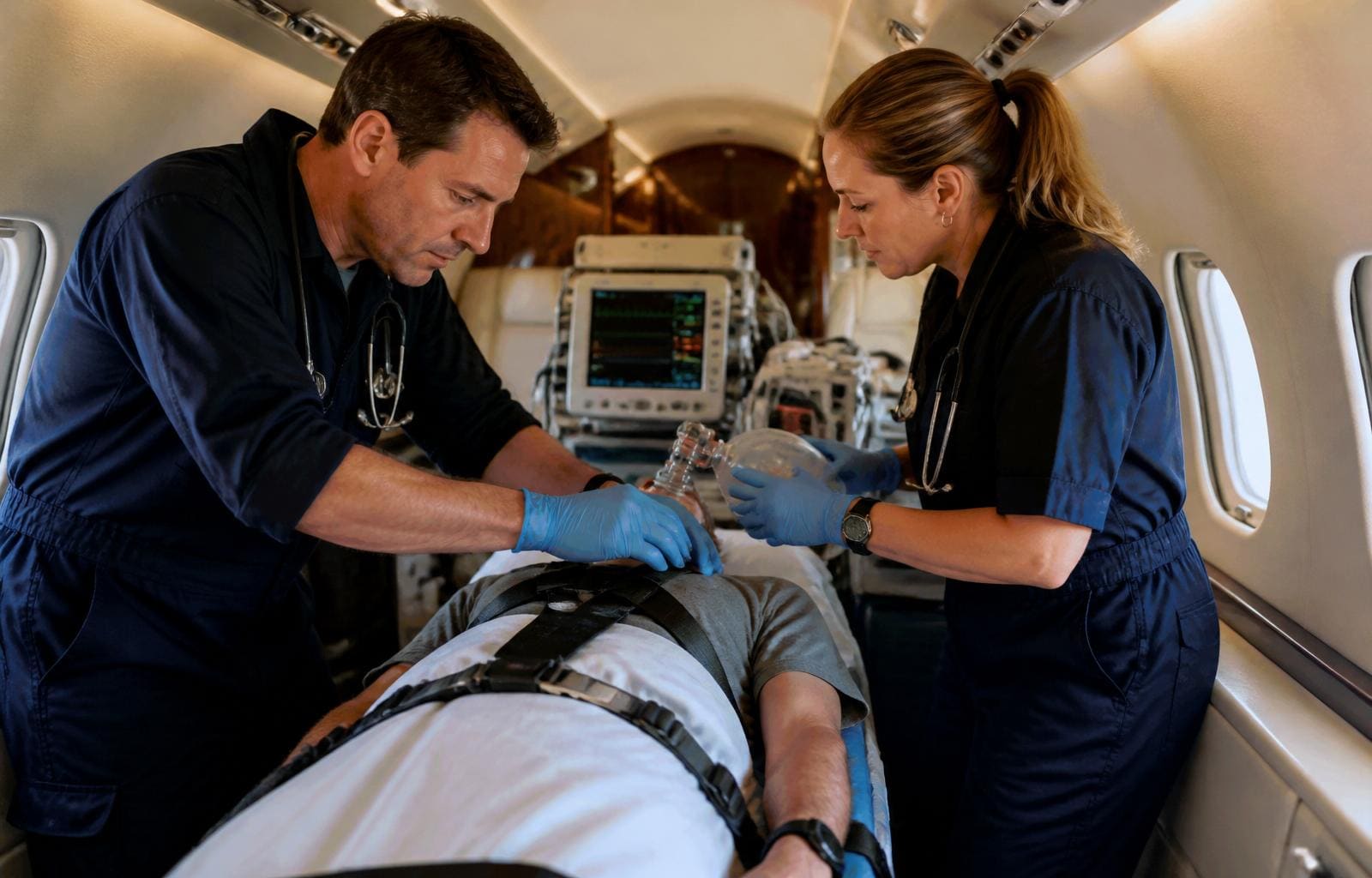
The cabin is configured as one for the mission: critical-care stretcher, transport ventilator, cardiac monitoring and defibrillation, infusion pumps, integrated oxygen with reserves, suction and an emergency drug pack, with the configuration matched to the patient by the flight physician.
Who do I call to start a Jeddah medevac?
The 24/7 medical operations hotline on +1 650 550 2734, or email charter@mega.aero with the patient's location, condition and destination.
Missions are flown by registered third-party operators with medically configured aircraft. Clinical acceptance by the receiving facility, crew and equipment suitability, permits and weather all govern departure.
Medevac services · Contact the 24/7 medical operations desk · charter@mega.aero