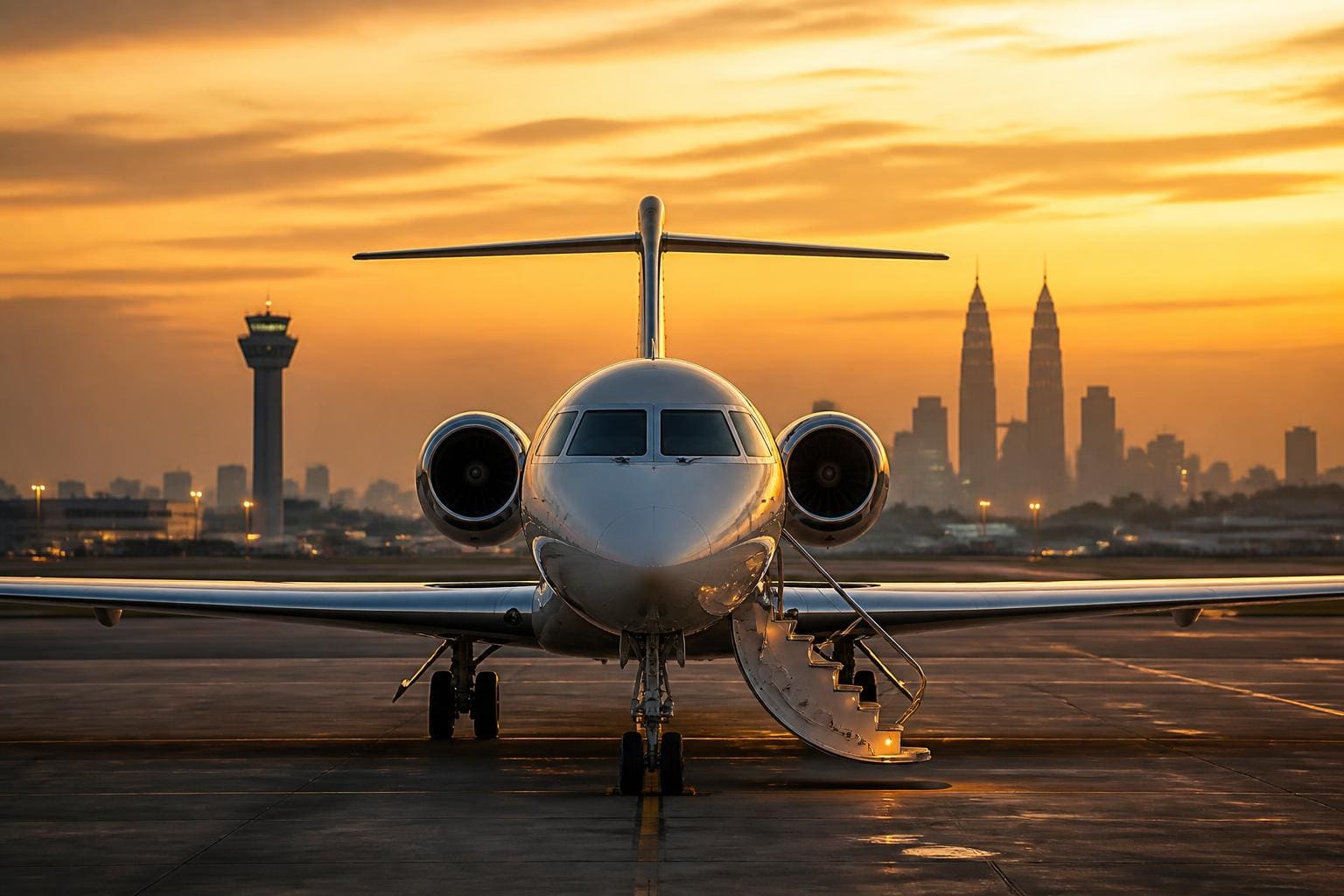
Private Jet from Bahrain to Kuala Lumpur
One aircraft, one crew, one unbroken seven-hour sector from Bahrain International to Malaysia’s capital. Built for executives, investors, motorsport guests and families who want to arrive rested, on their own schedule, through private terminals at both ends.
Flight Overview: Bahrain to Kuala Lumpur
The sector between Bahrain International Airport and Kuala Lumpur International Airport runs roughly 3,500 nautical miles across the Arabian Sea, the southern Indian flight information regions, the Bay of Bengal and the Andaman Sea before entering Malaysian airspace. It is a single-sector mission for any ultra-long-range aircraft and is flown regularly by Gulf-based principals, sovereign delegations, energy and commodity traders, private equity teams and families heading to Malaysia for business or for the resort coasts beyond the capital.
Typical block time is around seven hours fifteen minutes eastbound. Westbound legs usually run twenty to thirty minutes longer because of prevailing winds. Because Kuala Lumpur sits five hours ahead of Bahrain, the most requested profile is a late-evening departure from Bahrain that lands mid-morning local time, giving guests a full working day on arrival after genuine flat-bed rest rather than a fractured night in a shared cabin.
What separates a private mission on this pair from a commercial itinerary is not only speed. A scheduled routing almost always involves a transfer through Doha, Dubai or Abu Dhabi, exposing the trip to a missed connection and stretching door-to-door time to thirteen or sixteen hours. A dedicated aircraft is filed direct, departs on your window, and typically completes the entire journey in nine to ten hours from car door in Manama to car door in Kuala Lumpur.
Airport Information at Both Ends
Bahrain International (BAH / OBBI) operates around the clock with an established executive terminal, dedicated business handling and immediate ramp access. Its position at the head of the King Fahd Causeway makes it a practical departure point not only for principals in Manama but for the Eastern Province of Saudi Arabia, with Dammam and Khobar a short drive away.
At the Malaysian end there are two realistic choices. Kuala Lumpur International (KUL / WMKK) is the primary long-haul gateway, with two 4,000-metre runways, no restriction on heavy or ultra-long-range arrivals, and the Malaysia Airports VIP Complex offering private customs and immigration channels, sterile corridors and vehicle access to the ramp. Sultan Abdul Aziz Shah Airport at Subang (SZB / WMSA) is Malaysia’s dedicated business field, closer to the city centre and home to several FBOs and maintenance providers, and is often preferred for corporate movements where aircraft performance and slot availability permit.
Regional fields extend the mission once the aircraft has arrived. Langkawi (LGK), Penang (PEN) and Senai in Johor Bahru (JHB) all accept private movements, and short domestic legs are added on the same aircraft and crew without bag re-checks or main-terminal processing.
Business Travel to Kuala Lumpur
Kuala Lumpur is Malaysia’s commercial and financial capital and the headquarters city for energy, banking, palm oil, telecommunications and infrastructure groups. Meetings cluster in KLCC around the Petronas Twin Towers, the Tun Razak Exchange financial district, Bangsar South and Damansara Heights. Guests landing at Kuala Lumpur International reach the central hotel districts in thirty to forty-five minutes, and considerably faster from Subang.
Government and sovereign engagements usually take place in Putrajaya, the administrative capital, which sits between the main airport and the city and is under twenty minutes by chauffeured car from the ramp. Neighbouring Cyberjaya hosts a fast-growing cluster of data-centre, cloud and fintech investment that brings a steady flow of Gulf capital through Kuala Lumpur. For a delegation arriving to sign, inspect or negotiate, the ability to land, be processed privately and be in a boardroom inside an hour is the practical argument for charter.
Malaysia Business Opportunities
Bahrain and Malaysia share deep Islamic finance ties, and the corridor carries a recurring flow of sukuk, takaful, halal supply-chain and asset-management activity between Manama and Kuala Lumpur. Add to that renewable energy projects, semiconductor and electronics manufacturing in Penang, port and logistics investment in Johor, and the data-centre build-out around Cyberjaya and Johor Bahru, and the result is a route with genuine repeat corporate demand rather than purely seasonal leisure traffic. Firms flying it monthly typically move to a framework charter agreement with preferred aircraft categories and consolidated reporting.
Luxury Travel and the Cabin Experience
A seven-hour overnight sector is where cabin quality stops being a talking point and starts being the product. Ultra-long-range aircraft hold a low cabin altitude and elevated humidity, which materially reduces the fatigue and dehydration of a long flight. The forward club seats convert to lie-flat positions, the rear divan makes a full-length bed, and the largest types carry a separate master suite with an en-suite lavatory and shower.
Catering is built around the manifest rather than a trolley: halal menus as standard, kosher preparation, Gulf and Malay regional dishes, medically restricted diets and children’s menus. Ka-band and Ku-band connectivity supports video calls and secure file transfer across almost the entire route, including the Indian Ocean segment, so a board can work the first three hours and sleep the last four. Crew are briefed in the language of the passengers and service is calibrated to whether the cabin is a workspace or a rest space.
Formula 1 and Sepang Motorsport Travel
Sepang International Circuit lies minutes from Kuala Lumpur International and remains one of Asia’s landmark venues. It is the legacy home of the Formula 1 Malaysian Grand Prix and continues to host the Malaysian round of the MotoGP world championship along with major endurance and superbike categories. Race weekends draw team principals, sponsors, hospitality parties and private guests from Bahrain and the wider Gulf, and the circuit’s proximity to the airport makes a private arrival unusually efficient.
For those weekends we coordinate ramp arrival at Kuala Lumpur International, pre-cleared VIP processing, dedicated circuit transfer, and where calendars allow, continuation on the same aircraft and crew to Gulf motorsport rounds. Slot pressure during race weekends is real, so filing early materially improves the arrival window you get.
Executive Charter and Corporate Programmes
Executive missions on this pair are typically quoted in one call. We confirm aircraft options, an indicative price and a realistic departure window against live positioning, permit lead times and crew duty limits. Corporate accounts add framework agreements, preferred aircraft categories, monthly usage reporting and a named senior controller reachable at any hour. Every aircraft is sourced from licensed third-party operators. Any ARGUS rating, Wyvern status or IS-BAO registration is held by the relevant operator where applicable, with maintenance, training and insurance records reviewed on a per-mission basis rather than assumed from a prior booking.
What to See in Kuala Lumpur
Guests staying beyond the meeting calendar find the city compact and rewarding. The Petronas Twin Towers and the KLCC park sit at the centre, with the Batu Caves a short drive north, the Islamic Arts Museum among the finest collections of its kind, and Bukit Bintang offering the densest cluster of dining and retail. Beyond the capital, the Cameron Highlands, the Langkawi archipelago and the heritage streets of Penang are all within a short domestic leg on the same aircraft, which is why so many Bahrain departures are booked as a combined business and leisure itinerary rather than a return day trip.
Scheduling, Permits and Lead Times
Three to five days of notice gives the widest aircraft choice and comfortable lead time for overflight clearances along the routing, the Malaysian landing permit and the arrival slot. Shorter notice is routinely workable: when a suitable long-range aircraft is already positioned in the Gulf and crew duty windows are open, same-day and next-morning departures are achievable, and expedited permit handling is available when a deal or a medical situation compresses the schedule. What we will not do is quote a departure window we cannot defend, so the first call gives you an honest timeline rather than an optimistic one.
Crew duty is the constraint most often underestimated on a seven-hour sector followed by a same-day regional leg. Where an itinerary stacks Bahrain to Kuala Lumpur and then an onward hop to Penang, Langkawi or Singapore inside a single duty period, we either build in a rest stop or plan an augmented crew at the quoting stage. Getting that right in advance is the difference between an itinerary that holds and one that unravels on the day.
What Drives the Price
There is no per-seat fare on a private mission. The figure is built from aircraft category and age, where the aircraft has to fly from to reach Bahrain, fuel uplift at both ends, overflight and landing permits, handling and parking, crew duty and accommodation, and any waiting time in Malaysia if the aircraft stays with you rather than repositioning. A round trip with the aircraft on the ground in Kuala Lumpur for two nights is priced differently from two separate one-way legs, and one of those two structures is almost always materially cheaper depending on how long you stay.
The two levers that move the number most are aircraft choice and positioning. Accepting a technical stop on a super-midsize jet cuts the figure substantially for a party of six to eight who do not need a flat bed. Conversely, a delegation of eighteen with heavy baggage will find that a VIP airliner, quoted once, beats splitting across two long-range jets. Run the pair through the Flight Calculator first so the conversation with a controller starts from a realistic number rather than a guess.
Safety, Operators and Accountability
Every aircraft offered on this corridor comes from a licensed third-party operator. Any ARGUS rating, Wyvern status or IS-BAO registration is held by that operator where applicable. Maintenance status, pilot currency and insurance cover are checked per mission rather than assumed from a previous booking, and long oceanic sectors carry their own scrutiny of equipment fit, extended-range procedures and diversion planning across the Indian Ocean. If an aircraft does not clear those checks, it is not offered, even when it is the cheapest option on the market that day.
Accountability sits with a named senior controller rather than a queue. That person owns your mission from first enquiry through permits, catering, ground transport and arrival handling, and is reachable throughout the flight. On a route where a weather diversion or a slot change can affect a boardroom appointment five hours ahead in local time, having one accountable contact is worth more than a call centre.
Airports on the Bahrain-Kuala Lumpur Mission
Bahrain International
24-hour operations, executive terminal, immediate ramp access, causeway drive from Dammam and Khobar
Kuala Lumpur International
Primary long-haul gateway, VIP Complex with private customs and immigration, 4,000 m runways
Sultan Abdul Aziz Shah, Subang
Dedicated business field near the city centre, multiple FBOs and maintenance providers
Langkawi, Penang, Senai
Regional onward legs for resort travel and corporate site visits
Aircraft Options, Range and Passenger Capacity
Selection comes down to passenger count, baggage, onward legs and how much of the sector you intend to sleep. Ultra-long-range jets and VIP airliners fly it nonstop; super-midsize types need one technical stop and are usually the value option for smaller parties.
AIRCRAFT
PASSENGERS
RANGE
CABIN NOTES
Gulfstream G650ER / G700
13-16
≈ 7,000-7,750 nm
Quietest long-haul cabin, flat-bed rest zone, Ka-band
Bombardier Global 7500
14-17
≈ 7,700 nm
Four true zones, master suite, nonstop with full load
Bombardier Global 6000
12-14
≈ 6,000 nm
Proven Gulf-to-Asia workhorse, nonstop in most wind cases
Dassault Falcon 8X
≈ 6,450 nm
Three zones, low cabin altitude, strong short-field access
Airbus ACJ319 / Boeing BBJ
18-30
≈ 6,000-6,700 nm
Private suites, standing headroom, delegations and family groups
Challenger 350 / Praetor 600
8-10
≈ 3,200-4,000 nm
One technical stop, cost-effective for small parties
Private Charter vs Commercial Business Class
DIMENSION
COMMERCIAL VIA A GULF HUB
MEGA PRIVATE CHARTER
Door-to-door time
13-16 hours with a Gulf hub transfer
9-10 hours including private terminals
Stops
One connection minimum
Nonstop on a long-range aircraft
Departure control
Airline timetable
Your window, moved if plans change
Terminal experience
Main terminal queues
Executive terminal and VIP Complex
Working en route
Limited, shared cabin
Private conference group and secure Wi-Fi
Rest before meetings
Angled or lie-flat seat
Full flat bed in a low-altitude cabin
Group travel
Split seating and cabins
Whole party together, one manifest
Onward Malaysian legs
New ticket and terminal transfer
Same aircraft and crew
Related MEGA Pages
Flight Calculator
Indicative pricing for BAH to KUL and any other city pair, before you speak to anyone.
Empty Legs
One-way opportunities on repositioning aircraft, including occasional Gulf to Southeast Asia legs.
Bahrain to Malaysia
The wider corridor including Langkawi, Penang and Johor Bahru arrivals.
Business Flying in Saudi Arabia
Executive charter across Riyadh, Jeddah and Dammam, feeding Bahrain departures via the causeway.
GCC Flight Disruption Cover
Charter alternatives when scheduled services from Bahrain and the wider Gulf are disrupted.
On-Demand Charter
How MEGA sources, audits and dispatches aircraft worldwide, 24 hours a day.
Frequently Asked Questions
How long does a private jet take from Bahrain to Kuala Lumpur? +
Plan on roughly seven hours and fifteen minutes of block time eastbound and closer to seven hours forty-five minutes on the return, depending on winds aloft and the filed routing across the Arabian Sea and Bay of Bengal.
Is Bahrain to Kuala Lumpur a nonstop private flight? +
Which Kuala Lumpur airport should I arrive into? +
How many passengers fit on this route? +
Can a midsize jet fly Bahrain to Kuala Lumpur? +
How far in advance should I book? +
What permits are needed for the sector? +
What does a Bahrain to Kuala Lumpur charter cost? +
Is there a time difference between Bahrain and Kuala Lumpur? +
Which departure time works best for business meetings? +
What happens on arrival at Kuala Lumpur International? +
How long is the drive from the airport into the city? +
Do you arrange chauffeured ground transport in Malaysia? +
Is Wi-Fi usable across the whole route? +
Can we hold a board meeting in the cabin? +
What catering can be arranged? +
Do guests get a flat bed on the flight? +
How is baggage handled? +
Can we fly on to Langkawi or Penang after Kuala Lumpur? +
Can the aircraft continue to Singapore or Jakarta? +
Do you support motorsport weekends at Sepang? +
Which operators do you use? +
Can international guests join the flight in Bahrain? +
Are pets allowed in the cabin? +
How is privacy protected for high-profile guests? +
What if my meeting schedule changes mid-trip? +
Are empty legs available on this corridor? +
Do you offer corporate charter agreements for this route? +
What weather should we expect in Kuala Lumpur? +
How do I start a booking? +
Plan Your Bahrain to Kuala Lumpur Flight
Speak with a senior controller for aircraft options, an indicative price and a realistic departure window, usually within minutes of first contact.