Flying Private with Pets: A Practical Guide to the Cabin, the Paperwork and the Arrival
How dogs, cats and other companions actually travel on a private jet — and what has to be true on paper before they can.
TL;DR
On a private jet, dogs and cats travel in the passenger cabin beside you — no hold, no separation. The aircraft is rarely the hard part; the paperwork is. Most destinations need an ISO microchip, a current rabies vaccination, an official health certificate and often an import permit arranged in advance, and some add a rabies titre test with a waiting period. The order of these steps matters, and the binding word always sits with the receiving authority. Plan early, choose the aircraft around the animal, and confirm the current rules before you commit to dates.
The one thing that actually changes
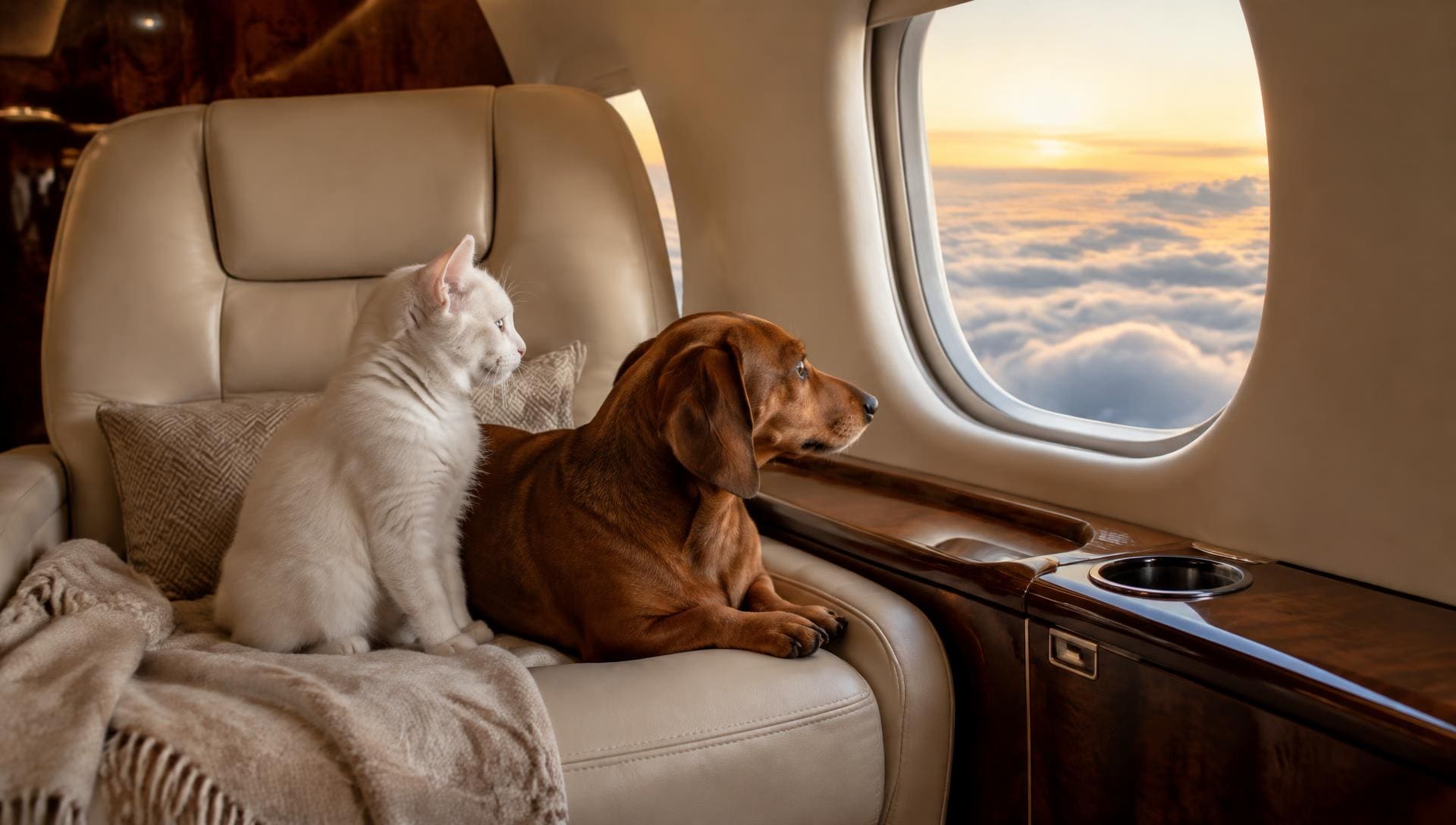
Ask anyone who has flown commercially with a large dog and they will tell you the same story: the animal checked in like luggage, a quiet worry held for the entire sector, and a reunion at the oversize belt. Private aviation removes that entire experience, because there is no hold in the equation. Your dog lies on the cabin floor beside your seat or sleeps on a divan. Your cat stays in its carrier on the seat next to you, where you can put a hand on it. The crew knew the animals were coming before you arrived at the aircraft, and the cabin — temperature, pressurisation, water, the occasional comfort stop on the tarmac — is run for everyone on board, four-legged included.
This is why people charter specifically for their pets, and why the requests we see are so consistent: elderly animals who should not be stressed, flat-faced breeds that airlines restrict from the hold, anxious rescues, multi-pet households relocating between homes, and families who simply will not put the dog in a crate in the dark. On our pet-friendly private jet charter page we cover the service itself; this guide is about how to think through the journey.
Choosing the aircraft around the animal
There is no seat map for pets, but there are practical shapes. A toy breed or a cat travels comfortably on almost any aircraft. A large dog is different: it needs floor it can actually occupy — enough to stand, turn and lie flat — and on anything beyond a short hop that points to a super-midsize cabin or larger, where the floor is wider and flatter. Long sectors with a big dog, or three or more animals travelling together, point to a large-cabin jet with a proper galley, because feeding and water on a long flight is a logistics question, not a kindness.
Tell your charter team about the animals at the same time you tell them about the people: species, breed, weight, age and temperament. An honest operator will tell you when a proposed aircraft is too tight, and that conversation is far better had before the quote than at the aircraft steps.
The paperwork is the flight
Here is the part that surprises first-time pet travellers: the aircraft was never the constraint. The documentation is. Almost every international destination builds on the same foundation — an ISO-standard microchip, a rabies vaccination recorded after the chip was implanted, and an official health certificate issued close to travel. Many destinations then add their own layers: a rabies antibody titre test with a waiting period after the blood draw, an import permit applied for in advance, or both.
Two things follow from this. First, the order matters — a rabies vaccination given before the microchip went in may not count, which is exactly the kind of detail that only surfaces when someone checks the file properly. Second, the rules change, and the binding word always sits with the receiving authority, not with a website, a kennel or a friend who did the trip last year. Any requirement mentioned here should be treated as orientation, and confirmed against your animal, your route and your dates.
What the main destinations expect
The UAE. Entry with a dog or cat typically requires an import permit arranged in advance, alongside the microchip, vaccination and health certificate foundation. The UAE also applies breed restrictions to certain dog types, so the breed conversation needs to happen at the planning stage, not at the border. On the day itself the arrival is the gentle part: the animal clears alongside you through the private terminal rather than being routed through a cargo shed.
Saudi Arabia. An import permit from the relevant Saudi authority, arranged with lead time built into the schedule. For families moving between Gulf homes seasonally, the permits become routine — but routine still means planned in advance, not requested the week of travel.
The United Kingdom. The UK is specific: microchip, rabies vaccination, an animal health certificate or a valid pet passport, and tapeworm treatment for dogs within a defined window where applicable. Private arrivals use approved airports, and the approval status of the field is confirmed for your dates as part of the plan. Lead times here punish improvisation.
The European Union. EU entry generally follows the pet passport or animal health certificate regime, with the same chip-and-rabies foundation. Within Europe, once in, movement between member states is comparatively simple — which is why so many Gulf-based families hold an EU pet passport for a dog that summers in France or Switzerland.
The questions we are asked most
*Can my dog really sit with me?* Yes. Beside you on the floor, on a seat, or on a divan. Some animals travel calmer in their own carrier on a seat, and that is fine too.
*How many pets can come?* There is no fixed limit on our side — the cabin is the limit. Three or more animals, or mixed species, simply shape the aircraft choice. Some destinations cap the number of animals per person, which is checked at quoting.
*Are some breeds a problem?* Not for the aircraft. Restrictions sit with destinations — the UAE maintains a restricted breed list, for example — so name the breed when you enquire and the current rules get checked for your route.
*What does it cost?* There is no fixed figure, and the pets themselves are part of the cabin plan rather than a separate fare. Price follows the aircraft, the route, the dates and the handling — every request is quoted individually.
When the animals are bigger than the cabin
Not every animal travels as a pet. Horses move on dedicated equine air transport — jet stalls on specialist freighters, attending grooms, sequenced health certification and quarantine — and our horse air transport charter page covers that world in detail. Falcons travel in the cabin under their own long-established conventions, often with CITES documentation. Breeding livestock and zoo transfers are their own discipline again. The umbrella for all of it is live animal air charter.
A sensible way to start
If a trip with a pet is on the horizon — a relocation, a summer in Europe, a second home in the Gulf — the first step is not choosing an aircraft. It is assembling the animal's file: chip number, vaccination record, any titre test already on record, and the destinations in play. From that file, the timeline writes itself: what is valid, what must be renewed, which permit sets the lead time. Then the aircraft follows the animal, and the flight itself becomes the easy part — which, for the animal stretched out asleep beside you at 45,000 feet, is exactly as it should be. When you are ready, request a quote and tell us who is travelling — all of them.