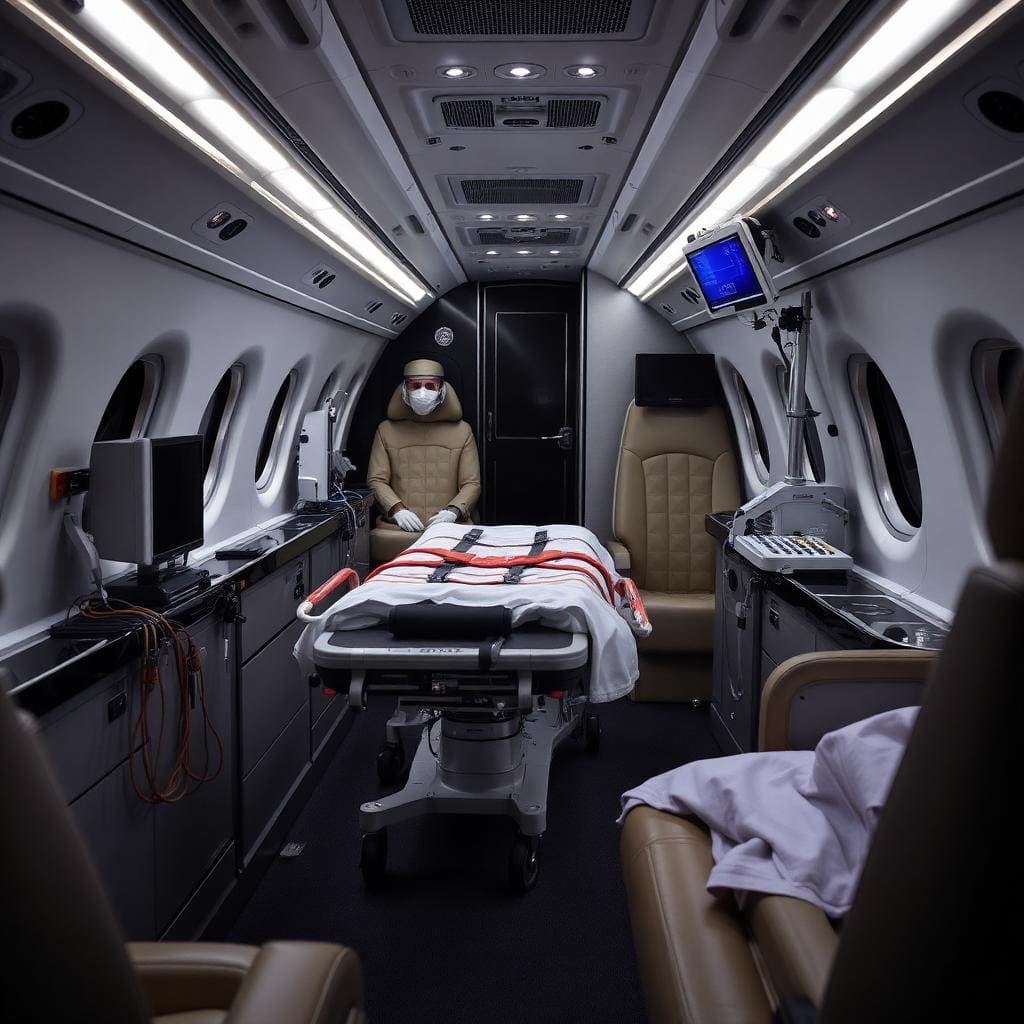
Air Ambulance Riyadh — ICU Medevac Flights
Riyadh combines two very different medevac patterns. The city's specialist hospitals receive patients from across the Kingdom, so a large share of our work is domestic — Tabuk, Abha, Yanbu, the Eastern Province — moving patients to a bed that only exists in the capital. The second pattern is international: Saudi patients travelling to Europe for treatment, and residents and visitors being repatriated home.
LAST UPDATED 5 SEPTEMBER 2026
Medical evacuation in and out of Riyadh
Saudi domestic medevac has its own operational grammar. Operator eligibility, GACA permitting, slot behaviour at King Khalid International and the pressure of the pilgrimage calendar all shape how a mission is planned. Our Riyadh desk works these details daily rather than looking them up.
Booking an air ambulance from Riyadh: what we need first
When a family, insurer or hospital contacts us about an air ambulance in Riyadh, the first conversation is clinical, not commercial. Our medical desk asks for the patient's current condition, diagnosis, ventilation and oxygen needs, mobility, and the name of the treating doctor. With that information, the flight physician can decide whether the patient is fit to fly, what level of care the cabin needs, and who must travel with the patient.
In parallel, we work on the practical side: a receiving hospital that has accepted the patient, the aircraft and medical team, permits and slots, and ground ambulances at both ends. A firm plan and quote are confirmed once the clinical assessment and the receiving hospital's acceptance are in place.
Information that speeds up planning
Domestic and international medevac from Riyadh
Riyadh's tertiary hospitals receive patients from across the Kingdom, so many missions bring a patient into the capital from a regional city. Others take patients out of Riyadh for treatment abroad — often to the UK, Germany or Switzerland — or repatriate residents and visitors to their home countries. Longer international sectors are flown on long-range medical aircraft so the medical team can work throughout the flight without unnecessary stops.
For patients who are stable and do not need intensive care in flight, a medical escort on a commercial flight or a stretcher arrangement may be considered, subject to airline acceptance and the treating doctor's advice. Our team will explain the options honestly rather than recommending a full air ambulance where it is not needed.
Private air ambulance versus commercial stretcher
Costs and insurance
Air ambulance costs depend on the distance, aircraft type, medical team, ground ambulances, permits and how long the team must stay with the patient. We do not publish prices; each case is quoted individually. Where travel or health insurance is involved, we can work with the insurer's assistance team, but coverage and approval are decided by the insurer.
Who operates the flight
MEGA Aviation coordinates air ambulance missions. Flights are operated by licensed partner air ambulance operators that hold the required approvals, and the medical team works under the operator's medical director. Every mission depends on clinical fitness to fly, receiving-hospital acceptance and the necessary permits, all confirmed before departure.
For wider Saudi coverage, see air ambulance and medevac in Saudi Arabia, or the Jeddah air ambulance page for the Red Sea region.
Airports and terminals used
RUH / OERK
King Khalid International
The arrival and departure point for Riyadh, with general aviation and executive terminal handling and direct ambulance access to the aircraft when arranged in advance.
TUU · AHB · YNB · HAS · GIZ
Regional Saudi fields
Domestic pickup points across the Kingdom, used to bring patients into Riyadh's tertiary centres. Runway length and hours of operation are checked case by case.
Transfer corridors we fly most from Riyadh
CORRIDOR
HOW IT IS USUALLY FLOWN
Riyadh ↔ London
The main treatment-travel corridor to the UK, flown on a long-range medical cabin so the team can work uninterrupted for the full sector.
Riyadh ↔ Frankfurt / Munich / Geneva
German and Swiss specialist referrals, particularly oncology, orthopaedics and complex cardiac work.
Riyadh ↔ Jeddah / Dammam / Medina / Tabuk
Domestic ICU transfers into the capital's specialist units. Short sectors where permits and bed confirmation set the pace.
Riyadh ↔ Dubai / Doha / Bahrain / Kuwait
Intra-Gulf transfers, frequently for a specific specialist team rather than distance.
Riyadh ↔ Delhi / Mumbai / Manila
Repatriation of expatriate residents, usually stretcher transfers with an escort rather than full intensive care.
Ground ambulance and hospital handover
Documentation and clearances
Aircraft matched to the case
Cabin selection follows the clinical picture and the sector length, not the other way round. The flight physician's assessment decides how the cabin is configured and who travels.
Light medical jet
Domestic Saudi sectors and short Gulf hops with a single stretcher and two-person medical team.
Midsize medical jet
Longer domestic legs from Tabuk, NEOM or Jazan and regional international work to Cairo, Amman or Istanbul.
Large-cabin medical jet
Europe and South Asia, with a full working area around the patient for the entire flight.
Ultra-long-range medical
Nonstop repatriation to Europe, East Asia or North America without a technical stop.
Riyadh air ambulance — frequently asked
Can you fly a patient between Saudi cities?
Yes. Domestic ICU transfers into Riyadh from Jeddah, Dammam, Medina, Tabuk, Abha and other regional airports are a regular part of our work. Operator eligibility for the domestic sector is confirmed at planning stage so the flight is legal as well as clinically appropriate.
Which airport is used for a Riyadh medical flight?
King Khalid International (RUH / OERK), with executive terminal handling and ambulance access to the aircraft arranged in advance. Regional Saudi airports are used for pickups elsewhere in the Kingdom.
Do pilgrimage seasons affect medevac in Saudi Arabia?
They affect the ground picture more than the flying. Apron pressure, handling capacity and hospital load all rise during Hajj and Umrah peaks, so plans need more margin. We build that margin in rather than assuming a normal week.
Can you take a Saudi patient to a hospital in Europe?
Yes — London, Frankfurt, Munich, Geneva and Vienna are frequently flown. Receiving-hospital acceptance is confirmed in writing before the aircraft is committed, and the flight physician manages the patient continuously to the point of admission.
Is the medical team Arabic-speaking?
We arrange for the crew and clinical team to be able to communicate with the patient and family, including Arabic-speaking clinicians where the case calls for it. Tell us the language requirement at enquiry stage.
How do I request an air ambulance from Riyadh?
Call +1 650 550 2734 at any hour or email charter@mega.aero with the patient's location, condition and destination. The clinical assessment starts immediately and runs alongside aircraft sourcing and permits.
How do I book an air ambulance from Riyadh?
Call or email our medical desk with the patient's condition, the treating doctor's details and the destination. A flight physician reviews the case, and we confirm the plan once the patient is fit to fly and a receiving hospital has accepted them.
Is a commercial stretcher possible instead of a private air ambulance?
For some stable patients it can be, subject to airline acceptance, stretcher availability and medical clearance. Our team will advise which option suits the clinical picture.
Does insurance cover an air ambulance from Riyadh?
It depends on the policy. We can work with the insurer's assistance team, but coverage and approval are decided by the insurer, not by MEGA.
Start a Riyadh medevac request
Tell us where the patient is, their current condition and where they need to go. Clinical assessment begins immediately and runs alongside aircraft sourcing, permits and receiving-hospital acceptance.